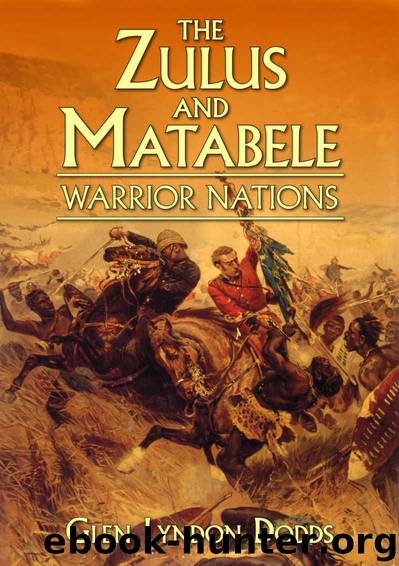
The Zulus and Matabele: Warrior Nations by Glen Lyndon Dodds
Author:Glen Lyndon Dodds [Dodds, Glen Lyndon]
Language: eng
Format: epub, azw3
Tags: Isandlwana, Zulu, Zimbabwe, Ndebele, Rorke's Drift, Anglo-Zulu War, Dingaan, Cetshwayo, Matabele, South Africa, Rhodesia
Publisher: Albion Press
Published: 2014-12-08T00:00:00+00:00
Rising tension
Tension mounted between Zibhebhu and Hamu on the one hand, and Ndabuko and fellow members of the uSuthu faction, as the royalists were known. The former pair, as beneficiaries of Wolseley’s settlement, were confident and assertive, and determined to retain their ascendancy. Ndabuko and his associates were angered by their own loss of status and influence and by the high-handed behaviour of Zibhebhu and Hamu. Therefore they were equally resolute, eager to uphold their own authority and promote their personal interests, as well as those of their exiled king and Dinuzulu.
The uSuthu faction sent two messengers south to the residence of the Bishop of Natal, John Colenso, at Bishopstowe just outside Pietermaritzburg. The bishop was sympathetic to the plight of the Zulu nation, which he believed—and it was an unfashionable belief in white colonial circles—to be the victim of an iniquitous war and an unjust settlement.
On 9 February 1880, the messengers arrived and declared that they had been sent by an impressive array of notables, including Ndabuko, three of his brothers and Mnyamana. Zibhebhu was oppressing the house of Mpande and seemed intent on destroying Cetshwayo’s family. The messengers asked Colenso if he thought it would be possible for them to request that Mpande’s children be freed from such pressure by being allowed to occupy a territory of their own. Colenso suggested that they visit the Acting Secretary for Native Affairs, John Shepstone, and sent a letter of introduction to him on their behalf.
The next day the messengers met Shepstone, who declared that the house of Cetshwayo had been destroyed; that it was out of the question that Ndabuko would receive any official recognition, and that any complaints against appointed chiefs should be made to the British Resident in Zululand.
Meanwhile, events far from South Africa were to fill Colenso with optimism that the lot of the Zulu nation could be improved. In April 1880, Disraeli and the Conservatives were ousted from power by Gladstone and the Liberals, partly as a result of a backlash in Britain against the Zulu War. On 24 April, Colenso wrote enthusiastically:
‘Now . . . something will be done, I presume, to rectify the enormous wrongs of the Zulu War & (so-called) Settlement . . . . The heart of England, I trust, is still beating rightly, & will expect that . . . the Liberals . . . shall do what can be done under existing circumstances to rectify the past.’
A week later, Ndabuko appeared before Osborn and requested permission to visit the Governor of Natal to pay his respects. He received authorisation, and with Shingana kaMpande (one of Cetshwayo’s half-brothers and the second most senior figure in the uSuthu party) proceeded to lead over 200 men into Natal, including twenty men of rank, most of whom came from the chiefdoms of Hamu and Zibhebhu.
The arrival in the colony of the deputation under Ndabuko at this juncture may have been entirely coincidental, but it has been plausibly suggested that the uSuthu had received word
Download
The Zulus and Matabele: Warrior Nations by Glen Lyndon Dodds.azw3
This site does not store any files on its server. We only index and link to content provided by other sites. Please contact the content providers to delete copyright contents if any and email us, we'll remove relevant links or contents immediately.
| Africa | Americas |
| Arctic & Antarctica | Asia |
| Australia & Oceania | Europe |
| Middle East | Russia |
| United States | World |
| Ancient Civilizations | Military |
| Historical Study & Educational Resources |
The Radium Girls by Kate Moore(12093)
100 Deadly Skills by Clint Emerson(4972)
Rise and Kill First by Ronen Bergman(4838)
The Templars by Dan Jones(4732)
The Doomsday Machine by Daniel Ellsberg(4545)
The Rape of Nanking by Iris Chang(4255)
Killing England by Bill O'Reilly(4042)
Stalin by Stephen Kotkin(4004)
Hitler in Los Angeles by Steven J. Ross(3978)
12 Strong by Doug Stanton(3575)
Hitler's Monsters by Eric Kurlander(3384)
The Code Book by Simon Singh(3250)
Blood and Sand by Alex Von Tunzelmann(3240)
Darkest Hour by Anthony McCarten(3161)
The Art of War Visualized by Jessica Hagy(3043)
Hitler's Flying Saucers: A Guide to German Flying Discs of the Second World War by Stevens Henry(2777)
Babylon's Ark by Lawrence Anthony(2718)
Tobruk by Peter Fitzsimons(2559)
The Second World Wars by Victor Davis Hanson(2554)
